
Muses & Musings with Choreographer Warren Carlyle
In my role as Columns Editor for SDC Journal, I interviewed choreographer Warren Carlyle for the Muses & Musings column, which highlights directors and choreographers sharing their current sources of inspiration. This was published in the Fall 2025 issue of the magazine.
Who or what inspired your career in theatre?
I grew up in a village in England, and the village didn't actually have its own theatre. So a lot of my early inspiration came from MGM movie musicals. Anything that Fred Astaire did, anything that Gene Kelly did—that was really my first access to dance of any kind.
I studied in the local dance school, and I graduated from there into full-time ballet school, just outside of London. Classical ballet was the bedrock of my training. Then I danced. I worked on 10 West End shows before I came to America. I danced lots of different styles, in lots of different productions. I was a swing, a dance captain, an assistant choreographer, and a resident director. I found an interesting path and I think those early MGM movie musicals led me to what I'm doing now. Big, bright, joyous shows. That's my hope.
Where do you get your inspiration now? Is it books, music, visual art?
One of my earliest memories is listening to music and imagining things. I think I just always had that thing—I hear music, and I see people moving. Now I sit in my apartment and listen to music and imagine people dancing.
I spend a lot of time in my scripts and in my music. I always have a dance arranger. I always have a drummer. I do research, but I try not to be bound by it or biased by it. Especially with some of the period things. Pirates!, as an example of that, is set in 1890. And if I was bound by period, I'd really be in trouble, I think; I don't know quite how I'd make that dance in the way that I have.

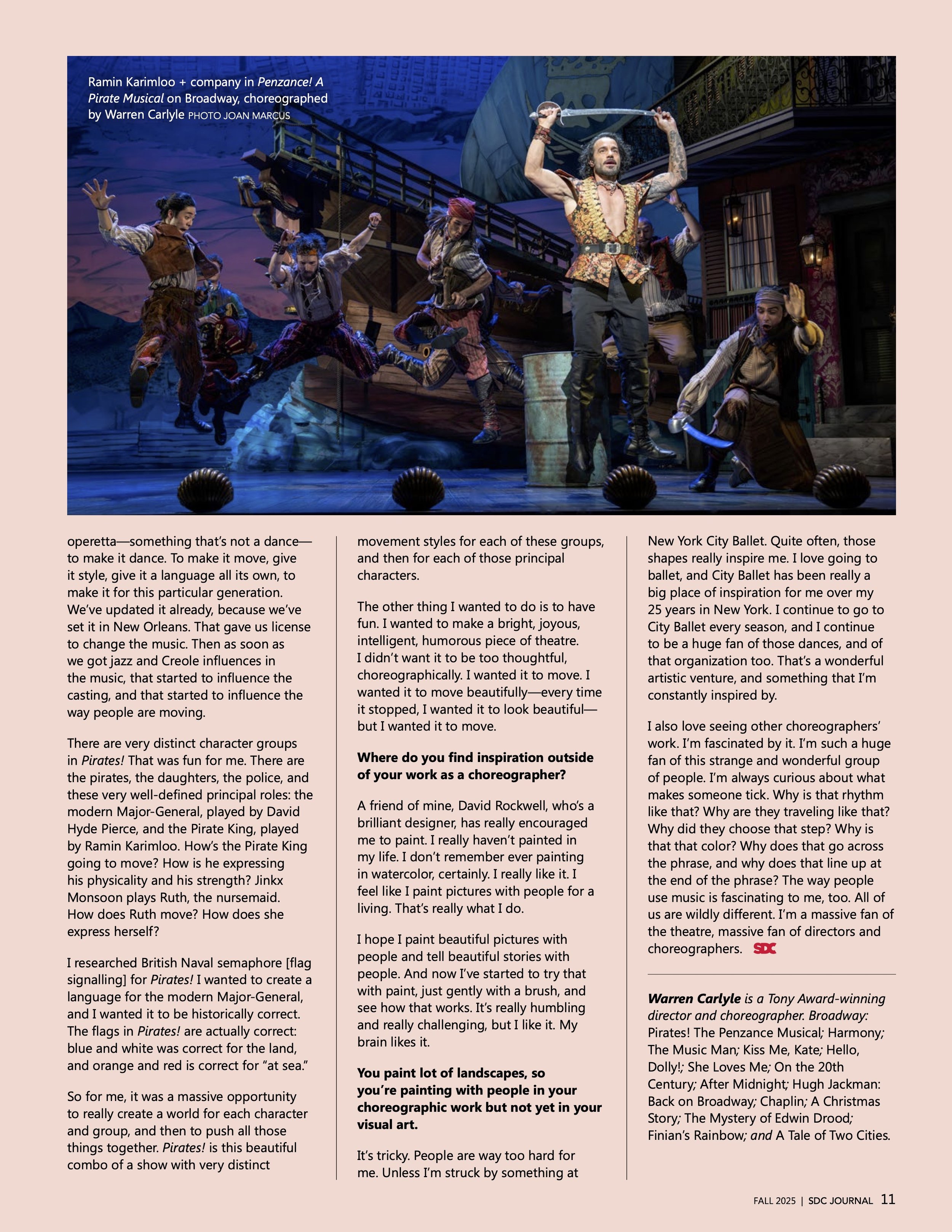
As we speak, your production of Pirates! A Penzance Musical, a reimagining of Gilbert and Sullivan's The Pirates of Penzance, has just opened on Broadway. Tell us about the world you created for that show, and what inspired it.
Pirates! is very much a kind of decoupage world. I wanted the dance to feel like that. The clothes—beautifully designed by Linda Sherwin—feel like that; the scenery—by David Rockwell, lit by Don Holder—feels like that. I wanted the choreography to be in the same world as the scenery and the costumes.
One of the biggest opportunities with Pirates! was to make something that's traditionally a Gilbert and Sullivan operetta—something that's not a dance—to make it dance. To make it move, give it style, give it a language all its own, to make it for this particular generation. We've updated it already, because we've set it in New Orleans. That gave us license to change the music. Then as soon as we got jazz and Creole influences in the music, that started to influence the casting, and that started to influence the way people are moving.
There are very distinct character groups in Pirates! That was fun for me. There are the pirates, the daughters, the police, and these very well-defined principal roles: the modern Major-General, played by David Hyde Pierce, and the Pirate King, played by Ramin Karimloo. How's the Pirate King going to move? How is he expressing his physicality and his strength? Jinkx Monsoon plays Ruth, the nursemaid. How does Ruth move? How does she express herself?
I researched British Naval semaphore [flag signalling] for Pirates! I wanted to create a language for the modern Major-General, and I wanted it to be historically correct. The flags in Pirates! are actually correct: blue and white was correct for the land, and orange and red is correct for "at sea."
So for me, it was a massive opportunity to really create a world for each character and group, and then to push all those things together. Pirates! is this beautiful combo of a show with very distinct movement styles for each of these groups, and then for each of those principal characters.
The other thing I wanted to do is to have fun. I wanted to make a bright, joyous, intelligent, humorous piece of theatre. I didn't want it to be too thoughtful, choreographically. I wanted it to move. I wanted it to move beautifully—every time it stopped, I wanted it to look beautiful—but I wanted it to move.
Where do you find inspiration outside of your work as a choreographer?
A friend of mine, David Rockwell, who's a brilliant designer, has really encouraged me to paint. I really haven't painted in my life. I don't remember ever having painted in watercolor, certainly. I really like it. I feel like I paint pictures with people for a living. That's really what I do.
I hope I paint beautiful pictures with people and tell beautiful stories with people. And now I've started to try that with paint, just gently with a brush, and see how that works. It's really humbling and really challenging, but I like it. My brain likes it.
You paint lot of landscapes, so you're painting with people in your choreographic work but not yet in your visual art.
It's tricky. People are way too hard for me. Unless I'm struck by something at New York City Ballet. Quite often, those shapes really inspire me. I love going to ballet, and City Ballet has been such a big place of inspiration for me over my 25 years in New York. I continue to go to City Ballet every season, and I continue to be a huge fan of those dances, and of that organization too. That's a wonderful artistic venture, and something that I'm constantly inspired by.
I also love seeing other choreographers' work. I'm fascinated by it. I'm such a huge fan of this strange and wonderful group of people. I'm always curious about what makes someone tick. Why is that rhythm like that? Why are they traveling like that? Why did they choose that step? Why is that that color? Why does that go across the phrase, and why did they line it up the end of the phrase? The way people use music is fascinating to me, too. All of us are wildly different. I'm a massive fan of the theatre, massive fan of directors and choreographers.
Warren Carlyle is a Tony Award-winning director and choreographer. Broadway: Pirates! The Penzance Musical; Harmony; The Music Man; Yes We Can; Katie; Hello, Dolly!; She Loves Me; On the 20th Century; After Midnight; Hugh Jackman: Back on Broadway; Chaplin; A Christmas Story; The Mystery of Edwin Drood; Finian's Rainbow; and A Tale of Two Cities.
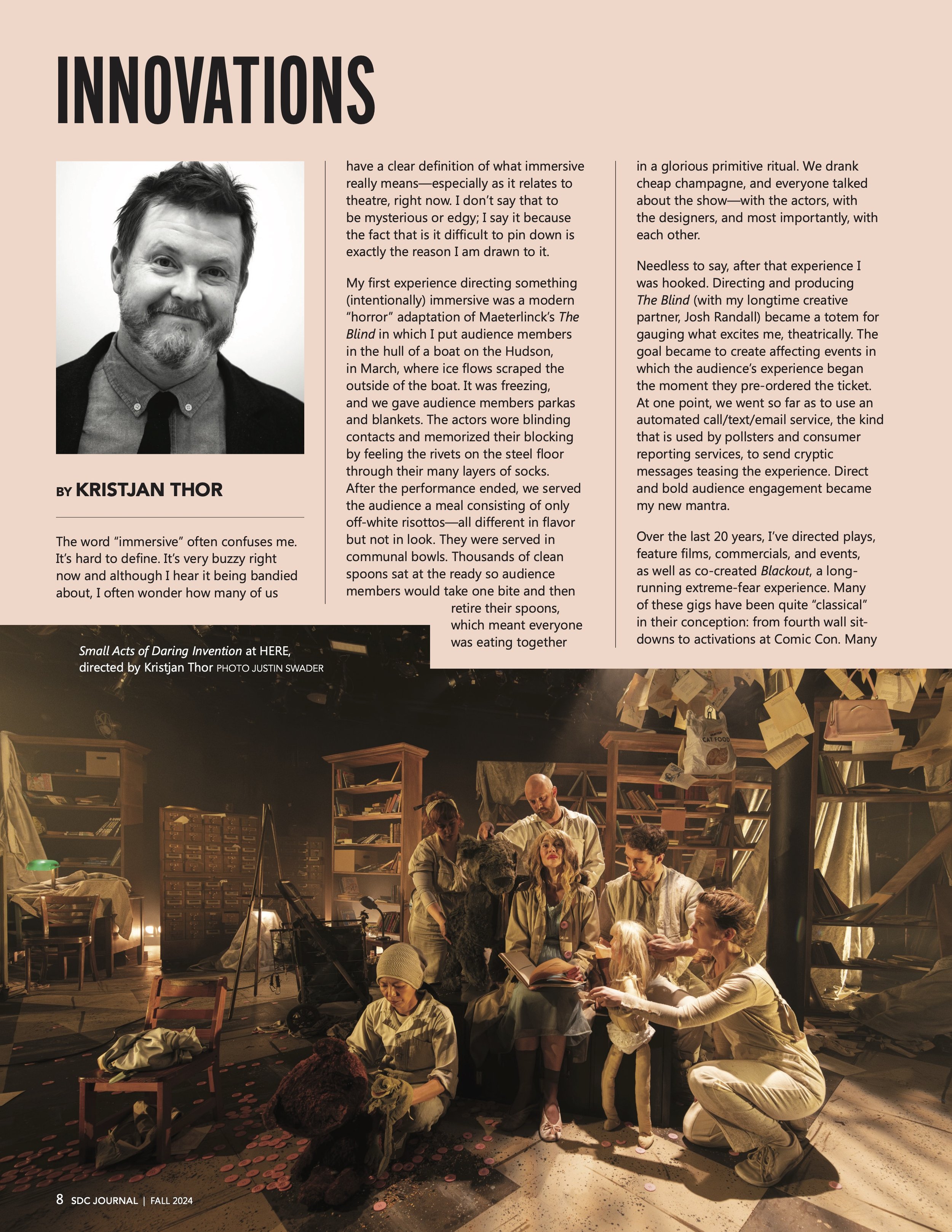
Innovations by Kristjan Thor
In my role as Columns Editor for SDC Journal, I edited Kristjan Thor ‘s piece for the Innovations column, which highlights directors and choreographers _________. This was published in the Fall 2024 issue of the magazine.
The word “immersive” often confuses me. It’s hard to define. It’s very buzzy right now and although I hear it being bandied about, I often wonder how many of us have a clear definition of what immersive really means—especially as it relates to theatre, right now. I don’t say that to be mysterious or edgy; I say it because the fact that is it difficult to pin down is exactly the reason I am drawn to it.
My first experience directing something (intentionally) immersive was a modern “horror” adaptation of Maeterlinck’s The Blind in which I put audience members in the hull of a boat on the Hudson, in March, where ice flows scraped the outside of the boat. It was freezing, and we gave audience members parkas and blankets. The actors wore blinding contacts and memorized their blocking by feeling the rivets on the steel floor through their many layers of socks.
After the performance ended, we served the audience a meal consisting of only off-white risottos—all different in flavor but not in look. They were served in communal bowls. Thousands of clean spoons sat at the ready so audience members would take one bite and then retire their spoons, which meant everyone was eating together in a glorious primitive ritual. We drank cheap champagne, and everyone talked about the show—with the actors, with the designers, and most importantly, with each other.
Needless to say, after that experience I was hooked. Directing and producing The Blind (with my longtime creative partner, Josh Randall) became a totem for gauging what excites me, theatrically. The goal became to create affecting events in which the audience’s experience began the moment they pre-ordered the ticket.


At one point, we went so far as to use an automated call/text/email service, the kind that is used by pollsters and consumer reporting services, to send cryptic messages teasing the experience. Direct and bold audience engagement became my new mantra.
Over the last 20 years, I’ve directed plays, feature films, commercials, and events, as well as co-created Blackout, a long-running extreme-fear experience. Many of these gigs have been quite “classical” in their conception: from fourth wall sit-downs to activations at Comic Con. Many less so: from deeply intimate plays in a basement for micro audiences to filling a brownstone with conceptual art and tens of thousands of discarded toy dolls. There is, however, always a desire to give the work a feeling of being all-encompassing, regardless of the genre.
When I study up on the theatremakers of the past hundred years, I immediately see that immersive has long been with us, it just wasn’t articulated as such. One thing that has changed is what working “immersively” means in today’s media landscape. The live experience continues to become more rarefied and scarce as screens and augmented reality move to the front of our daily lives. I don’t bemoan this change; in fact, I see many creators capitalizing on it and doing wonderful things with this new technology.
I do, however, hope that it will make the personal and intimate ability that is inherent in immersive theatre stand out as necessary in the world. Simple and personal gestures will begin to mean so much more in a theatrical experience: sitting alone with an artist intimately whispering their story to me, drifting into the suspended belief that we are the only two people in the world at that moment; being surprised when an actor’s hand is laid gently on my shoulder, both comforted and challenged by its presence; standing in a room that collapses into perfect and total darkness, left only with my thoughts, both terrified and exhilarated.
These are examples of some of the microcosmic moments that have stood out to me as simple, elegant examples of what immersive events can afford our audience. It’s not rocket science, but working with actors and designers to make these experiences present and necessary is what allows the aforementioned moments to stand out.
One thing I’ve come to understand is that performing in an intimate immersive piece requires a whole different set of skills than being on stage. Often actors who have worked with me “experientially” say it can be hard to go back to the stage because the feedback from the audience is not immediate, as it often is in immersive events. Sometimes actors can quite literally feel the audience react. That type of interactivity can be intoxicating.
With AI set to supercharge the output of consumable media, I think these live, human-driven experiences I’ve been describing will become more and more valuable. It is precisely because these types of events are not scalable that they resonate with audiences. Immersive theatre may also be an ideal foil to our relationship to our “personal devices,” ironically, because it is just that: personal.
Kristjan Thor is a critically acclaimed director of film, theatre, and immersive experiences based in New York. Over the course of a 22-year career, he has directed and produced two feature films and many theatre, short film, and video projects that have been recognized internationally.

Theatrical Passports with Arnaldo Galban
In my role as Columns Editor for SDC Journal, I interviewed director Arnaldo Galban for the Theatrical Passports column, which highlights directors and choreographers ______. This was published in the Spring/Summer 2024 issue of the magazine.
In a conversation with SDC Journal, SDC Associate Member Arnaldo Galban spoke about his experience with theatre and directorial style in Cuba, where he was born and began his career as an actor and director, and in the US, where he recently completed a Stage Directors and Choreographers Foundation Observership with director Saheem Ali on his production of Buena Vista Social Club at Atlantic Theater Company. Buena Vista Social Club dramatizes the making of the beloved Cuban album of the same name, following the stories of a group of veteran musicians as they record the classic songs. The show was Galban’s first experience with professional theatre in the United States.
What is the theatre scene like in Cuba?
In Cuba, we have so many talented artists but all the cultural institutions, all the venues, belong to the government, which means they’re paying your salary and they’re producing your plays. They can attend performances before opening night, watch what you’re doing, and decide if you’re opening or not.
Independent theatre is illegal in Cuba, because that means you’re doing theatre with your money, so the government can’t censor it. You can’t do theatre outside the institutions, and you can’t sell tickets. The government won’t say, “Oh, we don’t allow independent arts in Cuba,” but they will make sure that you can’t make independent theatre.
I had friends doing that work. They were put in jail, or they were threatened. It’s a very difficult environment if you want to be a free thinker and create something. Which is crazy, because the Cuban Revolution has invested so much money in cultural things in Cuba. You can go to a cinema for a few cents, or you can buy a book and it’s less than a dollar. Everything that’s cultural in Cuba is so affordable. They’re giving culture to the people, and at the same time asking you not to use your brain, which is so confusing.
As a young artist, you’re very confused, but also it gives you that kind of rebel spirit that says, “Oh, you don’t want me to do that? Now I’m going to do that, and I don’t care if I’m not making money.” It’s beautiful; you do it because you really want to do it, because you love it.


What was your directing experience like there?
I was directing, I was designing, I was building the lights. I learned that from one of my favorite teachers and theatre directors in Cuba, Nelda Castillo. She made everything in the theatre with her hands. I learned that from her. I built lights with tomato cans. I built whole electricity systems. It was an adventure.
What was your concept of a director then?
In Cuba, we don’t have a place where you can study directing. You can study as a playwright, a designer, an actor, a critic, but not a director. Almost all the directors I worked with in Cuba learned to direct by trial and error while they were actors in a very important company called Teatro Buendía and the director there supervised their processes.
Those directors inherited skills from her, but they also inherited her style. In Cuba, the director has the last word on everything. They tell people what to do all the time. That happens everywhere in Cuba: in your house with your dad, in all different kinds of work environments. But in theatre, they use a very tyrannical style. That’s the way I grew up, seeing these directors call actors names or humiliate them in front of the rest of the company. I think we inherited that because of politics in Cuba. Our authority model is, “If you are not with me, you’re against me. You’re the enemy.”
I learned a lot from the directors I worked with there, and I will always be grateful for that. But I think in Cuba, no one realizes we’re following a model or a style that is against creativity. Especially with theatre; it’s such a communal art. And I think that’s what I saw here with Saheem Ali on Buena Vista Social Club. In America, you are in a creative process, and you are co-creating with all these people that are part of the creative team.
How was Saheem’s style of directing different from your previous experience watching directors work?
Well, first of all, Saheem is so kind. He learned my name. He said hi to everyone. He took time to acknowledge that we were present in the room. He even took time to unite the company and have everyone introduce themselves, and ask, “How did you arrive here?” and “What is your connection with the material?” I saw people hopping up and sharing deep and emotional stuff, because he was able to create this environment that made people feel safe to share.
That’s him, that’s who he is as a person. The people he feels comfortable working with are also people with this style. They are very human, and humble.
Saheem also considered other people’s ideas. If he was talking about something, and he had an idea, and then someone suddenly realized, “Oh, there is this way of doing this,” he was able to say, “Oh, yes, let’s try that.” My previous experience with other directors was that they respond to other people’s ideas with, “Oh, I didn’t have that idea. I know it’s amazing, but I won’t say that, because that means you are more creative than me, and I can’t put my work at risk.” Saheem was able to be open and say, “Let’s try that,” and the show got richer and richer.
Does that style inform how you think about making work now?
The way I will approach the next thing will be different thanks to the experience I had with Saheem. I would love to imitate his style of inclusive directing, listening to everyone, being humble, that kind of thing.
I feel lucky to meet people who are showing me there’s a different way to be a star and a different way of being a talented director, and that doesn’t mean you feel you are above everyone.
Arnaldo Galban is a director, actor, and acting coach based in New York City.

Theatrical Passports with Garry Hynes
In my role as Columns Editor for SDC Journal, I interviewed director Garry Hynes for the Theatrical Passports column, which highlights directors and choreographers ______. This was published in the Winter 2024 issue of the magazine.
Druid Theatre’s DruidO’Casey project included three Sean O’Casey plays—The Plough and the Stars, The Shadow of a Gunman, and Juno and the Paycock—in marathon performances in New York City and Michigan in fall 2023. The plays, commonly known as the Dublin Trilogy, were originally written separately and staged individually in the 1920s at Dublin’s Abbey Theatre. Garry Hynes, Druid Theatre’s Co-Founder and Artistic Director and the director of DruidO’Casey, chose to stage them chronologically, in order of the dramatic events depicted—which span 1915–1922 and encompass Ireland’s Easter Rising, War of Independence, and Civil War—rather than in the sequence that they were written. While audiences were able to see individual plays on separate nights, the project was conceived and designed as one marathon production, to be experienced as one play in three parts.
While O’Casey’s plays, now considered Irish classics, are often treated naturalistically, Druid’s production design leaned into the theatricality of both the marathon event and O’Casey’s language and sensibility. Hynes’s direction highlighted moments that felt heightened, performative, and sometimes surreal.
What did the decision to stage the plays in chronological order teach you about them?
I’ve done two O’Casey productions in my career before this, and one of the things that’s always worried me a bit about the plays is that unless one does a very modern production or a production totally removed from O’Casey’s ground plans or the period, then you’re forced back into this world of the Georgian tenement or the Georgian House. Knowledge of it has slipped away with time and as a result, the signaling has gone very wrong, because living in a distressed Georgian room would now be only the recourse of the wealthy. I think that because we were doing the three plays together, I felt able to take the decision to set them in a world that didn’t have to go for those set of references because we had a better chance of creating our own world.
A number of things became clear as we really got into rehearsals. Because the plays—to our knowledge, and as much as we could research—have never been seen together, one after the other, they tend to be swapped out one for the other, or certainly Juno and Plough do. And it became very clear as we worked on them how detailed O’Casey’s use of the historic detail of the time was, to distinguish each play. The detail of the historic events fed into the domestic events in a way that I just was in awe of: the craftsmanship of that. A suspicion that I had—that the plays were first, haunted plays, and second of all, plays that haunted each other—very much affected me in the making of it.
How did you and your design team approach the monumental task of designing three separate plays into one marathon production?
I knew that we were going to more or less follow O’Casey’s ground plan, and I knew we were going to use the profile of the costumes. So then it became really a question of what material to use, what was the nature of the room?
O’Casey is often called naturalistic, but more and more, I don’t find that word useful to describe his work. His work is so performative, so it started to make sense to consciously acknowledge its performativeness by using flats, stage weights, and those kinds of references.
The use of color in the costume pieces (by set and costume designer Francis O’Connor and co-costume designer Clíodhna Hallissey) was striking.
We knew that we weren’t going to go for documentary realism, and I talked a lot about the need to be able to completely embrace the performative aspects: the music hall, the broad comedy, the ability to go from tragedy one second—I mean, [the character of] Bessie Burgess [in Plough], also our Juno, has to die at the end of the play—but I didn’t want that to stop us from absolutely bringing the characters to vivid life. Some of that thinking influenced us to go for a color range that would not necessarily have been available at that time. Say something like Nora’s yellow dress [in Plough]. It’s stunning. She would not have worn something like that. But that’s part of the conscious sense of “this is going to be as theatrical as we think O’Casey was in creating these plays.”


O’Casey wrote such beautiful female characters, who you clearly also have such respect for.
When I think of it, all I can think of is O’Casey’s dedication, I think it’s in Plough, to his mother, where he says, “To the gay laugh of my mother at the gate of the grave.” which I think is rather beautiful and wonderful and sums it up... It’s a wonderful celebration.
I think some of his celebration of women comes from the fact that—I don’t know if he ever said it—but that he was so aware of the awfulness of individuals’ lives and that in some way the women, while they worked incredibly hard and were so poor and so on, they still had a central place in life as mothers of their children, as rearers of a family. Whereas the men, as victims of the capitalist economy, really had so little of anything to give them dignity or a sense of purpose. Somehow I tend to feel that O’Casey felt that too.
How do you think O’Casey’s legacy reverberates in modern Irish literature and theatre? Are there playwrights that you feel are working in O’Casey’s vein?
Let’s put it like this, I don’t think they are, unless they’ve been influenced by O’Casey. Writers who write about Dublin or write urban plays and/or use a Dublin accent can easily be referenced to O’Casey. But what O’Casey does—and working on the plays like this made feel this even more—his influences were extraordinary. He was very much influenced by the music hall. He was influenced by the Irish theatre that he saw, and then the use of music, the use of language—obviously J.M. Synge would’ve been an influence of some kind. Then there was his work at the Abbey Theatre and whatever sort of influence that was to work with those actors on a consistent basis. I just think what he came up with, which has become—people use the word “O’Casey-like” or whatever, which can seem very hackneyed—I think he was extraordinary, extraordinary as a writer.
Garry Hynes is the Co-Founder and Artistic Director of Druid Theatre in Ireland and was previously Artistic Director of the Abbey Theatre, Ireland’s national theatre. In 1998, she became the first woman to win the Tony Award for Best Direction of a Play, for Martin McDonagh’s The Beauty Queen of Leenane.